When Your Best Mechanic Retires: The Workforce Crisis in Equipment Rental
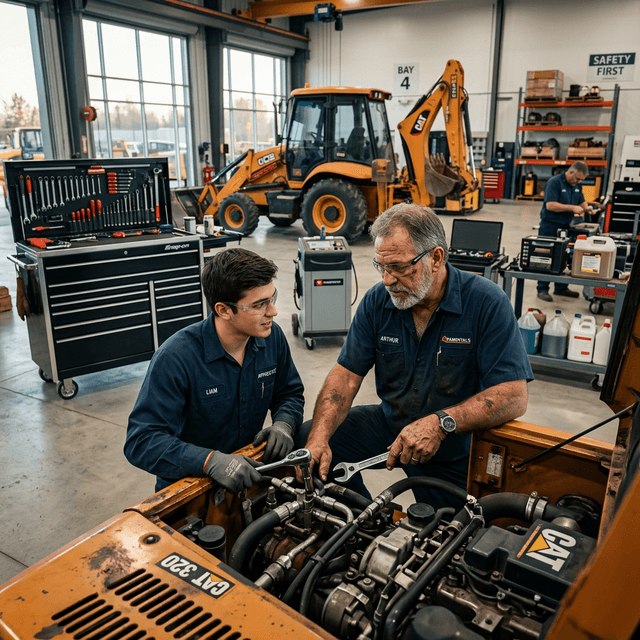
There is a moment every rental operator dreads, even if they have never put it into words. The mechanic who has kept the fleet running for twenty years — who knows every machine’s history, every quirk, every shortcut — walks into the office and says he is retiring in three months. And standing behind him is nobody.
This is not a story about one yard. It is happening across rental operations in India, Southeast Asia, the Gulf, and every mature rental market in the world simultaneously. The generation of mechanics who built the independent rental industry is leaving. The pipeline of trained replacements is thin. And the consequences of getting this wrong are not abstract — they are a breakdown on a live site, a customer who doesn’t come back, and a fleet that slowly becomes too expensive to maintain.
This is not a trend piece. It is a warning — and a practical one.
“The mechanic who has kept the fleet running for twenty years walks in and says he’s retiring in three months. And standing behind him is nobody.”
Where Did All the New Mechanics Go?
The shortage of trained equipment mechanics is structural, not cyclical. It will not resolve itself when the economy slows or when hiring budgets increase. Three forces are driving it simultaneously.
First, the work has changed faster than training has. Modern machines — telematics-equipped, electronically controlled, fault-code dependent — require a different skill set than the hydraulic and mechanical competencies that got the previous generation of mechanics through their careers. A technician trained a decade ago is not automatically equipped for the diagnostic demands of a 2023 JCB or Komatsu. The knowledge gap between experienced and new is wider than it has ever been.
Second, the perception of the trade has not kept pace with the reality of the pay. Equipment mechanics at competent rental operations earn well. But the pathway into the trade — apprenticeships, ITI programmes, OEM training — is not visible to the generation now entering the workforce. The talent is going elsewhere.
Third, and most critically for small operators: the knowledge is not documented. It lives in one person’s head. When that person leaves, it leaves with them.
- Knowledge Transfer: The average experienced mechanic carries 15–20 years of fleet-specific knowledge that has never been written down.
- Training Gap: Modern telematics-equipped machines require diagnostic skills that traditional ITI and apprenticeship programmes don’t cover.
- Retirement Timeline: The majority of experienced rental mechanics in Asia and the Gulf are 45–60 years old — a five to fifteen year window before the cliff hits.
- Replacement Rate: For every trained mechanic entering the equipment rental trade, an estimated three are leaving — and the ratio is worsening.
What Most Yard Owners Are Getting Wrong
The most common response to the mechanic shortage is reactive hiring — posting a vacancy when someone leaves, interviewing whoever applies, and hoping the new person can figure it out. This is expensive, slow, and increasingly unlikely to work as the pool of experienced candidates shrinks.
The second most common response is to do nothing, on the assumption that the problem is still years away. For operators whose senior mechanic is 52, it is not years away. It is the next health scare, the next family circumstance, the next better offer from a contractor who pays more.
The operators who are managing this well are doing two things differently: they are treating knowledge transfer as an operational priority, not an HR task — and they are building a training pipeline before they need it, not after.
“The knowledge lives in one person’s head. When that person leaves, it leaves with them. For small operators, that is not a workforce problem. It is a business continuity problem.”
How to Fix It: Strategies That Actually Work
Knowledge transfer does not require a formal programme. It requires a decision to start before the departure date is known. The most effective format for small operations is structured shadowing: a junior technician assigned to work alongside the senior mechanic on every job, with a simple log of what was done, why, and what to watch for. Over twelve months, that log becomes the institutional memory that the business currently carries in one person’s head.
OEM training programmes are underused by independent operators. JCB, Komatsu, Caterpillar, and Volvo all offer certified technician training — often subsidised, sometimes free for operators in their dealer networks. The operators who send junior staff through these programmes are building diagnostic capability that the open market cannot supply. They are also building retention: technicians who receive structured training stay longer.
What to Do Before Your Senior Mechanic Retires
- ✓ Start a machine history log now — every service, every fault, every repair, written down against the asset
- ✓ Assign a junior technician as a dedicated shadow — structured, not occasional
- ✓ Contact your OEM dealer about certified technician training programmes available to your team
- ✓ Document the three most common failure modes for each machine type in your fleet
- ✓ Build a relationship with a mobile diesel mechanic or specialist contractor as backup cover
- ✓ Have the retention conversation — what would it take for your senior mechanic to stay part-time for two years after retirement?
What’s Your Next Move?
The mechanic retirement cliff is not coming. For many operators, it is already here — quietly, one retirement at a time. The businesses that survive it well are not necessarily the ones with the biggest training budgets. They are the ones that recognised the risk early enough to do something boring and unglamorous about it: write things down, train someone junior, and have a conversation with a senior employee before it became urgent.
Every week you delay that conversation is a week of institutional knowledge that exists in one place — and that place is not getting any younger.