How to Keep Your Customers When the Big Guys Move to Town
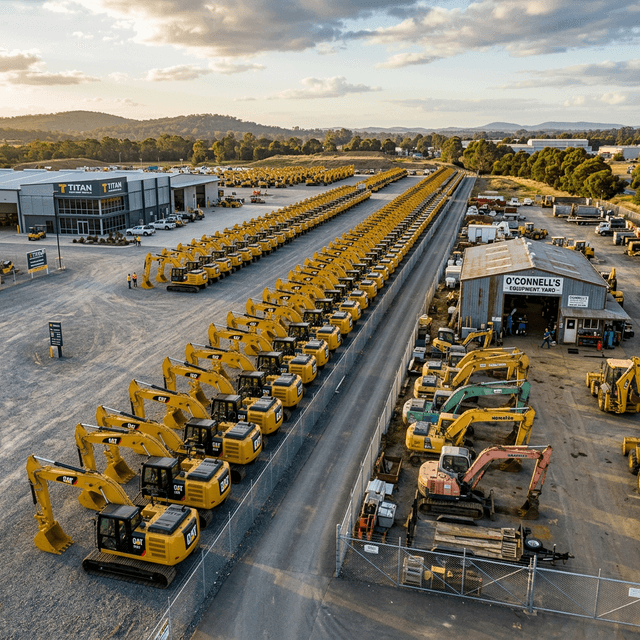
When Sunbelt Rentals lists on the NYSE and analysts start writing about equipment rental as an asset class, the coverage lands in two places: the financial press, which covers it as an investment story, and the trade press, which covers it as a validation story — proof that the rental industry has arrived. Neither of those framings is particularly useful if you are running fifteen machines from one yard and trying to decide whether to buy two more.
The useful question is a different one: what does institutional capital flowing into equipment rental at scale actually do to your competitive environment? The answer is not simple, and it is not uniformly bad. But it is real — and most independent operators are not thinking about it deliberately enough to respond to it well.
“When Sunbelt lists on the NYSE, the story in the financial press is about investors. The story that matters for independent operators is what happens to their competitive environment next.”
What Happens When Wall Street Moves In?
Large rental companies backed by institutional capital do three things that directly affect independent operators — not over a decade, but over the next two to three years.
They expand geographically into markets that were previously underserved. Institutional capital enables depot rollout at a pace that organic growth cannot match. A market that was previously too thin for a national player becomes viable when a listed company can absorb the ramp-up cost against a portfolio of profitable locations. For independent operators in secondary cities and regional markets who have operated without large-player competition, this is the most immediate threat — and it is already happening in Tier 2 and Tier 3 markets across India, Southeast Asia, and the Gulf.
They compress rates in the segments they enter. Large players with lower cost of capital, bulk purchasing power on fleet, and technology-enabled utilisation management can operate profitably at rates that squeeze independent operator margins. They do not always use that advantage aggressively — but the ceiling on what the market will bear in a given segment drops when a well-capitalised competitor enters it.
They raise customer expectations on documentation, compliance, and service standards. A contractor who has worked with a large national player — and experienced standardised check-out processes, digital rental agreements, and systematic damage documentation — brings those expectations to their next interaction with an independent operator. The baseline for what “professional” looks like in rental has moved. Operators who have not moved with it are losing bids they do not realise they are losing.
| What Large Players Do | Direct Impact on Independent Operators | Response That Works |
|---|---|---|
| Expand into secondary markets | Competition enters markets previously protected by geography | Deepen local relationships before the depot opens — not after |
| Compress rates in entered segments | Margin pressure in commodity earthmoving and general plant | Move toward specialised segments and customers where scale is not an advantage |
| Raise documentation and compliance standards | Contractor expectations rise — independent operators who haven’t kept up lose bids silently | Systematise check-out, photo documentation, and digital agreements now |
| Invest in technology and telematics platforms | Reporting and fleet visibility gap widens for operators still on spreadsheets | Use OEM telematics — it’s free and answers the same questions |
Your Secret Weapon: Where the Big Brands Can’t Compete
The instinctive response to large-player competition is to compete on price. This is the wrong response — it plays directly into the advantage that institutional capital creates. A listed rental company with a lower cost of capital and bulk fleet purchasing will always be able to sustain lower rates longer than an independent operator can.
The right response is to identify and defend the segments where scale is genuinely not an advantage — and there are more of them than most operators recognise.
Specialised and niche equipment categories — categories too small to anchor a national player’s fleet strategy but large enough to support a focused regional operator — are structurally protected from institutional competition. A 15-machine operator who becomes the most reliable source of a specific equipment type in a region has a defensible position that a depot rollout does not automatically threaten.
Local relationship density is the second protection. A national player can open a depot. It cannot replicate twenty years of contractor relationships, site knowledge, and the phone call that gets answered at 6am. Operators who have invested in those relationships — and continue to invest in them as large players enter their markets — retain a customer loyalty advantage that no fleet size or technology platform can easily displace.
“A national player can open a depot. It cannot replicate twenty years of contractor relationships and the phone call that gets answered at 6am.”
Your Action Plan: How to Defend Your Turf Today
The window for independent operators to respond to institutional capital entering their markets is before the large player arrives — not after. Once a well-capitalised competitor has established a local presence, the conversations that matter have already happened: the contractor has already evaluated both options, the rate conversation has already been had, and the relationship that was not secured is now harder to recover.
How to Compete When Institutional Capital Enters Your Market
- ✓ Identify your three highest-value contractor relationships and deepen them — before a competitor makes the same call
- ✓ Systematise documentation: digital rental agreements, photo check-out and check-in, service records — match the professional baseline large players have set
- ✓ Move at least one segment of your fleet toward specialisation — a category or application where you are the regional expert, not a generalist
- ✓ Know your cost floor per machine — if a large player compresses rates, you need to know exactly which jobs you can afford to walk away from
- ✓ Use your local advantage deliberately — response time, site knowledge, flexibility on short notice — and make sure customers know these are things the depot down the road cannot match
- ✓ Watch where large players are opening depots — regional property registrations, planning applications, and job postings are early signals worth tracking
What’s Your Next Move?
Institutional capital entering equipment rental is not a threat to every independent operator equally. It is a threat to the ones who compete on the same dimensions as large players — general fleet, commodity rates, no particular specialisation — in markets that are large enough to attract a depot rollout.
For operators who are genuinely embedded in their local markets, serving specific customer relationships, operating in segments too specialised for a national fleet strategy, the arrival of a well-capitalised competitor is a pressure, not an ending. The operators who have prepared — who have deepened relationships, tightened documentation, and found the segments where being local and expert matters more than being large — will find that the depot opening down the road is less consequential than it looked from the outside.
The ones who haven’t prepared will find out what institutional capital does to a competitive environment the hard way.