Who Really Owns Your Fleet Data? The Answer Might Surprise You
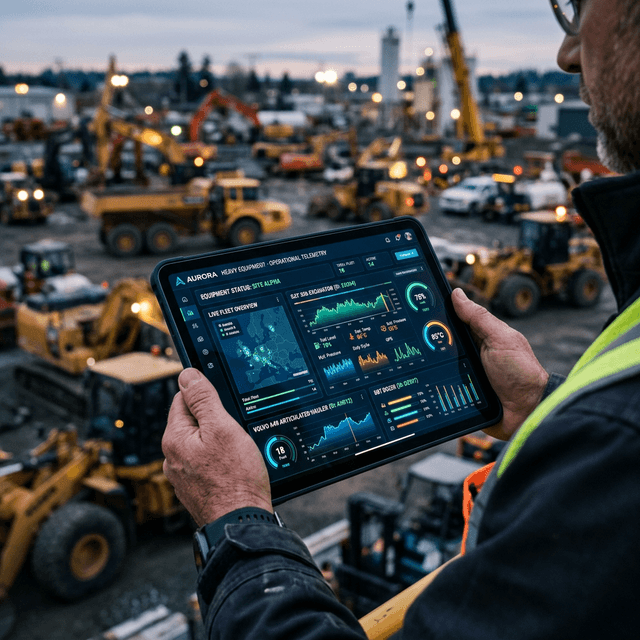
On March 2, 2026, Sunbelt Rentals rang the opening bell on the New York Stock Exchange. The same week, John Deere quietly completed the acquisition of Tenna — a mixed-fleet construction technology platform. And on February 26, United Rentals and Procore announced that rental telematics data would flow directly into the construction management software that project managers use to run their jobsites.
Three events. One week. A structural shift in who controls equipment data.
For decades, fleet data belonged to the rental company. Your utilisation logs, maintenance history, GPS records — that was yours. It moved when you decided it moved. That’s changing. And if you haven’t read your telematics contract recently, now is the time.
“Data about rental equipment may be more valuable than the equipment itself — and the window to negotiate your terms is now, not after you’ve signed.”
What John Deere Is Really Buying
Tenna isn’t a simple GPS tracker. It’s a construction technology platform for contractors running mixed fleets — Deere, Caterpillar, Komatsu, Volvo, all managed in one dashboard. That’s the entire point.
By acquiring Tenna, Deere inserts itself into every equipment decision its customers make, even when the machine on the jobsite isn’t a Deere. The platform generates utilisation patterns, maintenance cycles, operator behaviour data, and jobsite productivity metrics — all of which now flows into a system owned by the world’s largest construction equipment manufacturer.
Deere says Tenna will continue operating independently. That may be true today. The data, however, is a different question.
Let’s Look at the Real Numbers
| Metric | Value |
|---|---|
| United Rentals fleet telematics-enabled | 85%+ |
| Assets on Sunbelt’s connected IoT platform | 600K+ |
| Units on EquipmentShare’s T3 platform | 235,000 |
| Rental operators with fully integrated systems | 16% |
Why United Rentals Made a Genius Move
The Deere/Tenna deal is an OEM buying a software company. The United Rentals/Procore integration is something else entirely — and more immediately relevant to operators.
United Rentals wired its telematics data directly into Procore’s Resource Management solution. Procore is what project managers use to run construction projects — timelines, budgets, resources. It’s the operating system of the modern jobsite.
What this means in practice: contractors renting from United Rentals can now see location, utilisation status, and alerts for that equipment directly inside Procore. No switching apps. No manual data export.
United Rentals calls this the “first step” in a broader strategy of open, AI-driven integrations. Translation: they are building toward a world where their data is so embedded in their customers’ workflows that switching rental companies has a hidden cost beyond price and fleet quality.
“They are positioning themselves not just as an equipment provider but as data infrastructure. The fleet is the hardware. The data is the product.”
Caterpillar Wants Your Data Too
At ConExpo 2026, Caterpillar launched Cat AI Assistant and deepened its Geotab partnership to integrate on-highway vehicle data into VisionLink — giving customers a single platform across Cat and non-Cat assets alike.
The key word is “non-Cat.” Caterpillar is not just building a platform for its own equipment. It’s building the operating environment for entire mixed fleets, with Cat at the centre. When Caterpillar becomes the interface for your whole operation, switching brands carries a new cost: you lose your operational history.
The One Question You Better Be Asking Yourself
Here it is plainly: when you signed your telematics agreement, your fleet management subscription, your rental software contract — what did you agree to about your data?
Data clauses vary enormously. Some explicitly state the vendor owns anonymised, aggregated data for benchmarking and product development. Others are vague. Some permit sharing with “partners” — a category that can stretch broadly.
For large operators, legal teams review these terms. For independent businesses with 10–20 machines, the software agreement was probably accepted on the day of onboarding. That wasn’t a meaningful risk when your telematics company was a neutral third party. It looks different when it’s owned by the manufacturer of your equipment.
Quick Checklist: Protect Your Data Today
- Does the vendor retain rights to anonymised or aggregated data from your fleet?
- Can they share your data with “partners” or use it to train AI models?
- What happens to your historical data if you cancel or don’t renew?
- Does the platform allow full data export in a standard, portable format?
- Has the vendor been acquired recently? If so — re-read the agreement.
Your Playbook: Don’t Let Them Take Your Data
This is not an argument against telematics or fleet management software. The ROI is real and well-documented: lower downtime, better utilisation, stronger customer service. The businesses that have integrated these tools are measurably more efficient.
But knowing who controls your data changes how you make decisions going forward:
- Treat fleet data as a business asset with its own ownership and portability considerations.
- Ask about data rights before signing any new software contract — not after.
- Prefer platforms that let you export your data cleanly in standard formats.
- If a software company you use gets acquired, review your data agreement at next renewal.
- Don’t assume you’re too small to matter. Aggregated data from small operators is exactly what OEM-owned platforms are built to collect at scale.
What’s Your Next Move?
A new competitive layer is forming above the rental fleet — and it’s built from data. OEMs are acquiring the software that sits on top of mixed fleets. Large rental companies are building data integrations that deepen customer dependency. The businesses that will be disadvantaged are the ones that let their operational data accumulate inside platforms owned by suppliers or competitors, without reading the terms.
The window to negotiate data ownership is before you sign — not after you’re locked in. In rental, readiness creates value. That applies to your fleet. It applies to your data too.