Data Centers: The Secret Goldmine for Equipment Rentals
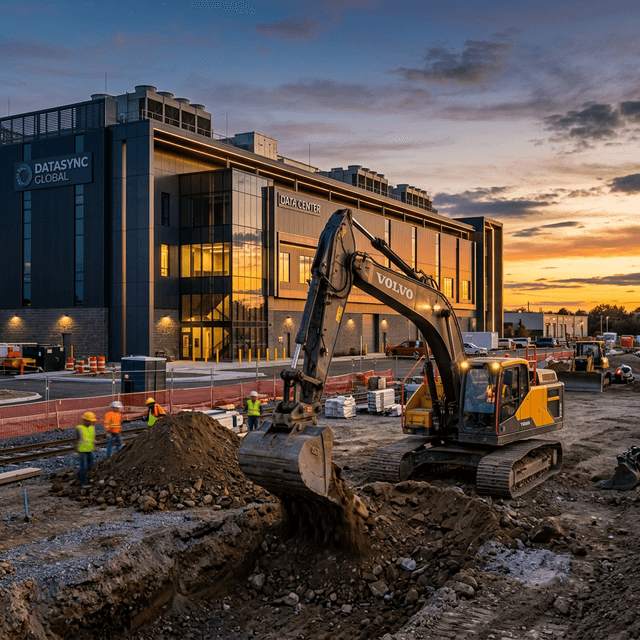
There is a construction hoarding on the edge of a business park near you. The client name means nothing. The end user is Microsoft, or Google, or a sovereign wealth fund building the Gulf’s answer to both. The building going up is a data centre. The excavator breaking ground came from a rental yard. Possibly yours.
Most operators serving data centre construction sites do not know that is what they are doing. The work comes in through a Tier 1 contractor, the machines go out, the invoices get paid. Nobody on site is explaining that the floor you are helping pour will eventually cool servers running AI workloads for half the planet.
That invisibility is costing you money. Here is why — and what to do about it.
“The excavator breaking ground on a data centre came from a rental yard. Possibly yours. Most operators don’t know that’s what they’re doing.”
Why This Market Is Different
Data centre construction is not a project. It is a programme. Hyperscalers do not build one facility — they build campuses, then expand them, then start the next one before the first is commissioned. Operators who get onto a data centre programme win a relationship, not a contract. That is a fundamentally different commercial dynamic than a road job or a residential tower.
Three things make this market worth understanding specifically.
- The timelines are relentless. Data centre commissioning dates are set by global infrastructure teams. A delayed generator is a programme failure, not a site inconvenience. Clients will pay a premium for reliability — which means this is not a commodity pricing conversation.
- The geography is shifting. The obvious markets — Mumbai, Dubai, Singapore — are well-covered by large players. The opportunity for regional operators is one ring out: Navi Mumbai, Dammam, Johor Bahru, Kolkata’s outskirts. Locations where national fleet coverage is thin and a reliable local operator has a genuine edge.
- The fit-out phase is where the margin is. Groundworks is competitive earthmoving. MEP fit-out — generators, precision cooling, cable-handling equipment — is where data centre rental gets interesting. Operators with that inventory, documented and ready, are in a different conversation.
The Compliance Filter
The barrier to entry here is not equipment. It is paperwork — and that is good news for operators who are prepared, because it eliminates most local competition at the qualification stage.
Hyperscaler procurement teams ask predictable questions: Do you have a quality management system? Can you produce maintenance records? Do you carry adequate liability cover? Can you respond to a breakdown on a live site at 2am?
Operators who can answer yes — even as a sub-vendor to a larger rental company — get inside a procurement system that generates repeat work without repeat tendering. Get qualified once. Work for years.
The Generator Opportunity
If there is one asset class at the centre of this market, it is the generator. Temporary power during construction. Load testing at commissioning. Permanent standby generation during operations. The demand does not stop when the building is finished.
Operators with well-maintained, well-documented generator inventory — particularly in the 100kVA to 2000kVA range — are holding the most in-demand asset in the data centre construction cycle. The constraint in most markets is not availability. It is documentation and response capability.
If your generators are going to general construction sites when they could be positioned toward data centre contractors, you are leaving a meaningful rate premium on the table.
How to Position for Data Centre Rental This Quarter
- Identify Tier 1 contractors active on data centre programmes in your region — and introduce yourself before the next tender
- Pull maintenance records for your generator fleet — documentation is your entry ticket
- Check your liability cover against data centre contractor requirements — most require higher limits than general construction
- Build a 24/7 response protocol — data centre clients will ask for it at qualification
- Consider sub-vendor qualification with a larger rental player already on a data centre panel — the fastest route inside
What’s Your Next Move?
You do not need to understand artificial intelligence to benefit from the decade of infrastructure it requires. You need reliable machines, clean maintenance records, and a phone that gets answered at 2am.
The AI economy runs on physical infrastructure. Physical infrastructure runs on construction equipment. That chain ends at your yard. The operators who recognise that deliberately — and position for it — will look back on this decade as the one that changed the scale of their business.
The ones who don’t will keep wondering why the contractor down the road is buying new machines every year.