ConExpo 2026: What's Actually Worth Buying?
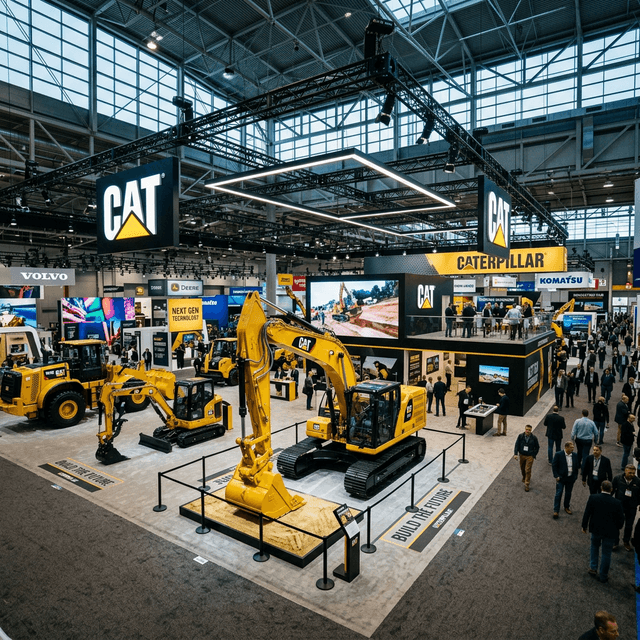
Every three years, the equipment industry descends on Las Vegas, builds the most expensive temporary city in construction, and spends five days telling each other that everything is about to change. The autonomous machines gleam under the lights. The renders are beautiful. The press releases are confident. And the operators watching from home have seen this before.
ConExpo 2026 followed the pattern. There was genuine innovation on the show floor — announcements that will affect purchasing decisions, rental rates, and fleet composition over the next five years. There was also a considerable amount of theatre: concept machines, prototype demonstrations, and roadmap promises that may or may not survive contact with a dealer network and a production line.
This is not a press release aggregation. This is a read of what actually matters for operators running real fleets — and what you can file away and forget.
“Operators have seen too many concept machines that never ship. The question after every ConExpo is not what was announced — it’s what will actually be in a dealer yard in eighteen months.”
Hype vs. Reality: Which New Tech Was Just for Show?
The framework is simple. Real means: you can order it, price it, or plan around it now. Theatre means: it was on a stand, it was impressive, and nobody could tell you a delivery date or a price. Both have value — theatre tells you where the industry is heading — but only one of them affects your fleet decisions this year.
| What Was Shown | Verdict | Why It Matters (or Doesn’t) |
|---|---|---|
| Telematics-native machines across all major OEMs | Real | Every major OEM confirmed telematics as standard fit, not optional, on 2026 and 2027 models. If you are buying new iron, your data infrastructure question is already answered. |
| Autonomous and semi-autonomous earthmoving | Theatre | Impressive demonstrations. No rental-ready pricing. No dealer availability timeline. File under “watch in 2028.” |
| Electric compact equipment (sub-5 tonne) | Real | Multiple OEMs confirmed order books open. Charging infrastructure remains the constraint — but for urban sites and indoor applications, the business case is now legitimate. |
| Hydrogen-powered heavy equipment | Theatre | Every major OEM had something on a plinth. None had a production date. The infrastructure question alone makes this a 2030+ conversation for rental operators. |
| AI-assisted diagnostics via OEM platforms | Real | Komatsu, Cat, and JCB all demonstrated predictive fault detection integrated into existing telematics portals. No new subscription required for fleet operators already on OEM platforms. |
| Fully integrated rental management platforms | Theatre | Several software vendors demonstrated end-to-end fleet-to-invoice platforms. The demos were polished. The implementation timelines and SME pricing remained conveniently unspecified. |
So, Should You Actually Buy Any of This Stuff?
If you are buying compact equipment in the next twelve months — mini excavators, skid steers, compact track loaders — the electric conversation is now worth having with your dealer. Not because the economics are obviously superior, but because the gap has closed enough that application-specific cases — urban demolition, indoor construction, noise-restricted sites — now pencil out. Rental rates on electric compact kit are running 15–20% above diesel equivalents in the markets where they have been deployed. That premium is holding.
If you are considering a telematics upgrade, stop. Every machine leaving a factory floor in 2026 comes with OEM telematics built in. The third-party telematics subscription conversation is over for new purchases. For older fleet, the OEM portal question remains — but the answer has not changed: log in weekly, pull the hours, flag the service intervals. The platform is already paid for.
If you were excited by the autonomous earthmoving demonstrations, give it two more cycles. The technology is real. The rental-ready version — durable enough for customer misuse, insurable, serviceable by a field technician — is not on a dealer lot yet. It will be. It is not now.
“The autonomous machine on the ConExpo stand is real technology. The rental-ready version — durable enough for customer misuse, insurable, serviceable in the field — is not on a dealer lot yet.”
The Only News Big Enough to Care About
Buried beneath the concept machines and the keynote renders was the announcement that attracted the least press coverage and will have the most practical impact on independent operators: the expansion of OEM certified pre-owned programmes across Asia and the Gulf markets.
JCB, Komatsu, and Volvo all confirmed structured CPO rollouts for their respective dealer networks in India, UAE, and Southeast Asia during 2026. For operators looking to expand fleet without new-machine capital outlay, a manufacturer-certified used machine with a warranty and documented service history is a materially different proposition than the open used market. This is worth a conversation with your dealer before the programmes fill up.
Your Quick Action Plan: What to Do Next
- ✓ Talk to your dealer about electric compact equipment if you serve urban, indoor, or noise-restricted sites
- ✓ Ask about OEM certified pre-owned programmes — CPO rollouts in Asia and Gulf are confirmed for 2026
- ✓ Log into your OEM telematics portal and enable AI-assisted diagnostic alerts if your platform now supports them
- ✓ Ignore autonomous heavy equipment for fleet planning purposes until 2028 at the earliest
- ✓ Do not sign a new third-party telematics contract for machines bought in 2025 or later
What’s Your Next Move?
ConExpo is always partly a trade show and partly a theatre production. The ratio varies by cycle. 2026 was heavier on theatre than most — the hydrogen and autonomy announcements were impressive and premature in roughly equal measure.
What was real: electric compact equipment with open order books, telematics as standard fit across new iron, AI diagnostics arriving inside platforms you already pay for, and CPO programmes that will change the used equipment market in Asia and the Gulf.
That is enough to act on. The rest can wait for Las Vegas in 2029.